Introduction
This article explains how to configure server identity on a Webdock server, including domain mapping to the web server (Apache/Nginx), hostname configuration, and reverse DNS (PTR) record assignment.
Adding Your Domains
The Server Identity screen allows you to assign domains to your server by defining a primary domain and optional aliases.
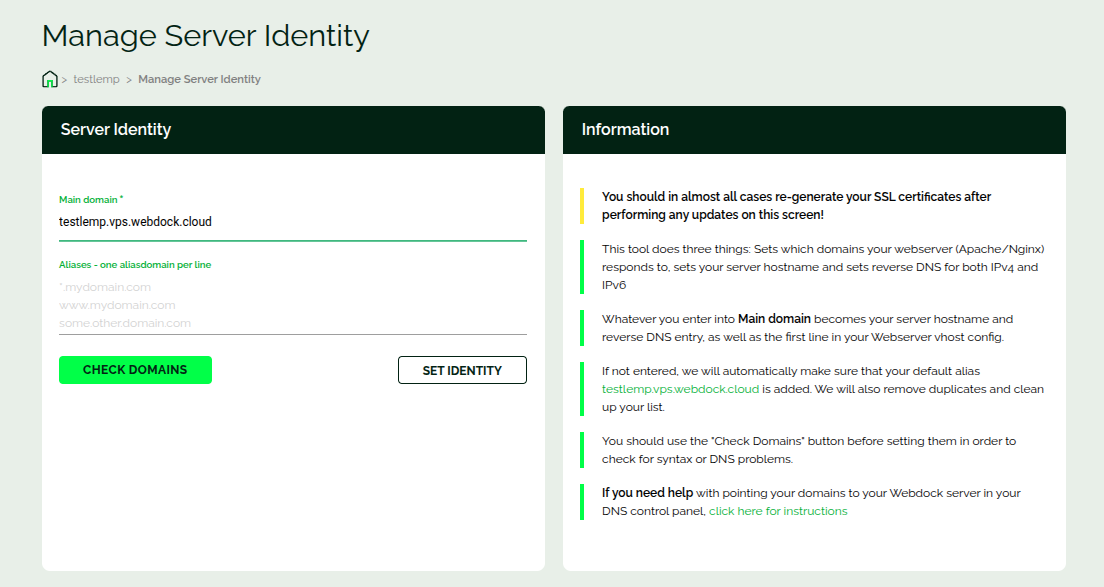
The Server Identity tool performs three core configuration tasks:
- Defines which domain names the web server (Apache or Nginx) responds to by configuring domain-to-virtual-host routing.
- Sets the system hostname based on the primary domain (e.g., ‘server.example.com’).
- Configures the PTR (reverse DNS) record using the primary domain, enabling proper reverse IP resolution for services such as email delivery.
Note: This tool does not manage DNS records. Before using it, you must create the required ‘A’ and ‘AAAA’ records in your domain provider’s DNS configuration, pointing to your server’s IP address.
Note: If you plan to generate SSL certificates, you must configure the domain using this Server Identity tool first. The SSL tool (available only on LEMP/LAMP images) requires domains to be registered on the server before certificate issuance.
Conclusion
The Server Identity tool centralizes domain configuration, allowing you to map domains, set the hostname, and configure reverse DNS from a single interface. This ensures your server responds correctly to requests and is properly prepared for services like SSL certificates and reliable email delivery.


